
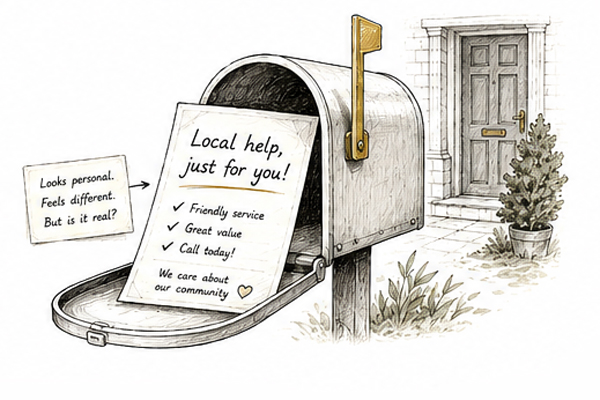

You know those leaflets that come through the door looking like they’re handwritten? At first glance, they work, don’t they? It catches your eye and you pause because it looks personal, or at least more personal than the usual pile of takeaway menus and “we buy gold” leaflets. Someone has actually written this. It’s different. Perhaps it matters?
You pick it up, look closer and quickly realise that what you thought was handwriting is actually just printed. It’s simply a font that looks like handwriting for the express purpose of deceiving you and thousands of other householders. The little imperfections are not imperfections at all. They are part of the design. And as soon as you realise this is all fake, the differentiator disappears. Not only that, but a little bit of you feels stupid for having been manipulated.
A little bit of you feels stupid for having been manipulated
Now, you’ve learned the tell-tale signs and you recognise the pattern. The next time something comes through the door in that same fake-handwritten style, looking just a little bit too evenly sized or all the same flat colour, you won’t pause. You already know what it is. It’s mass marketing disguised as personal attention.
Unfortunately, I think a lot of AI-written communication is heading in the same direction.
This is NOT an AI is bad article
I’m not going to pretend this is a simple “AI is bad” argument. It isn’t. I use AI as a tool in many of my workflows with careful oversight including when I’m planning out a blog post, like this one. It has huge value in helping me organise my thoughts into a coherent draft that I can then edit until the final piece accurately reflects my thinking and intent rather than the tool’s default voice.
Because let’s be honest here. You don’t get original lived judgement from AI. It reproduces patterns from existing content. It’s an averaging machine, and to stand out we can’t risk being seen as average.
You don’t get original lived judgement from AI
There is a big difference between using AI to help give form to your thoughts and outsourcing your thinking to it. There is an even bigger difference between using AI to draft and letting AI become the voice.
That difference matters because business communication is not just there to transfer information. It is there to build trust. A service page, a proposal, a sales email, a personal newsletter or a consultancy article all carry signals about the person or business behind them. Do they understand the problem? Have they done this before? Is there real judgement here? Does this feel considered? What unique value do they add?
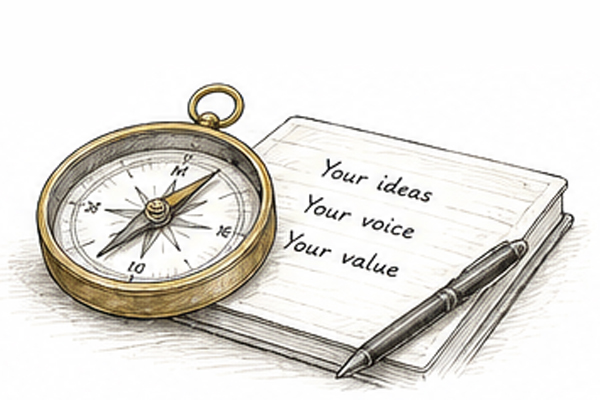
When communication starts to sound generated and you begin to see repeated patterns in structure or phrasing, trust can disappear very quickly. Even if the thinking in the copy is genuine, the reader may notice the pattern before they notice the value. That is especially risky when the brand, product or service is built around personal attention, expertise and care.
I liken this to a pop-up appearing just before I click the “buy” button on a website. It can derail the entire purchase. The offer inside the pop-up may be useful, but the interruption blocks the value. AI tells can do something similar. They create friction between the reader and the message, causing people to abandon it on the assumption that it is low-value AI-generated copy without much human involvement.
The problem isn’t AI. It’s pattern recognition.
We’re all starting to recognise the shape of AI-written copy. You see it on websites, in emails, on LinkedIn, in service pages, sales copy, newsletters, outreach messages, lead magnets and disappointingly, books.
The writing has a certain rhythm to it: short dramatic statements, slightly over-polished reassurance, neat “not this, not that” structures, confident but oddly generic claims, over-use of particular words like “quietly”, and phrases that sound emotionally intelligent without feeling particularly lived in (like this one).
Often, the writing isn’t technically bad and that’s part of the problem. It’s usually clear, structured and readable. It may even be better than what the person would have written from scratch, especially if they struggle to get their ideas out of their head. But it can still feel strangely empty, like very advanced space filler text. Lorem ipsum but a bit more fancy.
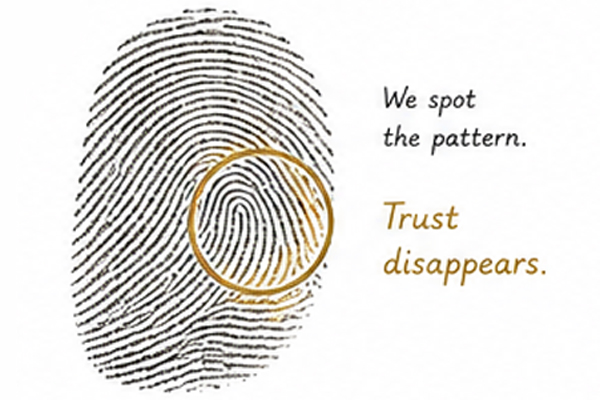
Trust doesn’t disappear because there’s no information there, but because the human signal has been smoothed out. The rough edges, humour, hesitation, specificity, opinion and lived experience have been polished into something that could have come from almost anywhere.
This is still a risk even when using style guides to guide the AI. It is incredibly hard to maintain a tone of voice that accurately reflects your own writing style, which is ironic considering AI’s obsession with structure and rules. That’s when copy starts to feel low value, even if there was a valuable thought behind it.
I’ve suspected this direction of travel for a while now, often butting heads over it with people with more clout than me. But I think I’m right. There is some research beginning to back this up. A study published in the Journal of Business Research looked at what happens when consumers believe marketing communication has been written by AI. The researchers found that AI-authored marketing communications can be perceived as less authentic than human-authored ones, which can then reduce positive word of mouth and customer loyalty.
AI-authored marketing communications can be perceived as less authentic
That feels important because it moves the issue away from whether the writing is technically competent. The question is whether the reader believes there is real human judgement, care and intent behind it.
Readers are subconsciously looking for patterns. For reasons to stop reading. If they see the pattern, they stop. If they don’t see the pattern, they continue until they do or until they get what they came for. These patterns become gates between the reader and the copy. Often, the amount of effort involved in removing all the tells from AI copy is more laborious than having just written it yourself in the first place.
AI can make good thinking look generic
This is the bit that bothers me most. The obvious argument is that AI makes it easy to produce lazy content. That’s true enough. If someone prompts a tool, accepts the first draft, and publishes it with barely any thought or involvement, the result will probably feel generic and hollow.
But there is a more specific risk depending on the reader. The patterns are going to be obvious to anyone with more than an ounce of pattern recognition ability, someone who has read a lot of your content before, or someone who knows you and how you communicate. That last one is the big risk.
Clients, customers and relationships are hard won and costly to acquire. But these are also the people most likely to see the patterns in your content, and they are the relationships you most need to nurture.
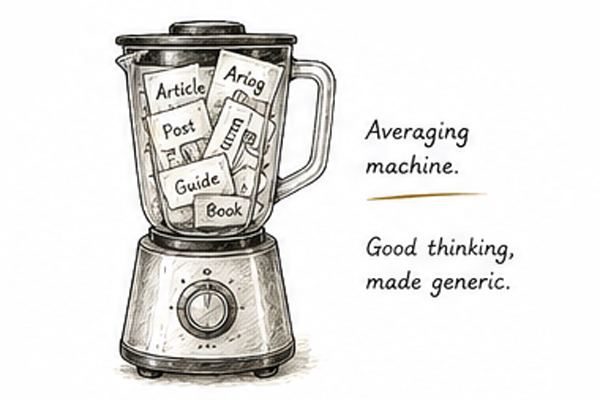
There’s a more damaging problem too. Someone can put genuine thought, care and experience into an idea, then use AI to help express it, only for the final version to pick up enough recognisable AI patterns that the human value gets obscured because the reader abandons the copy before the value can be communicated.
The insight may be real, the judgement may be hard-won, and the experience behind it may be genuinely useful. But if the finished piece looks and sounds like everything else people are learning to ignore, the reader may never get far enough to see the value underneath. They see the pattern first and mentally file it under “more AI content”.
The reader may never get far enough to see the value
That feels like the real shame to me. AI is supposed to help people communicate their thinking more clearly. Used carelessly, it can do the opposite. It can make original thinking look like generic content.
For consultants, freelancers, small businesses and expert-led brands, that is a serious problem. Your value is not just in having words on a page. Your value is in judgement, taste, experience, context, and the ability to notice what matters and say something useful about it. If AI helps you express that, great. If AI masks it or causes your readers to abandon your content, you have a problem.
Initial ‘success’ could lead to significant opportunity cost later
This is where I think AI-written communication has something in common with pop-ups.
None of us like pop-ups. They get in the way. We ignore their content because it tends to block us from achieving our current task. We either comply quickly to get rid of it or we look for the X to close it.
Pop-ups often “work” if you measure the obvious number. They may grow a mailing list, increase a conversion rate, or get more people to click the thing you want them to click. But anyone who has worked around websites for long enough knows there can be another cost: irritation, friction, interruption, reduced trust and a learned behaviour to close the box before reading what it says.
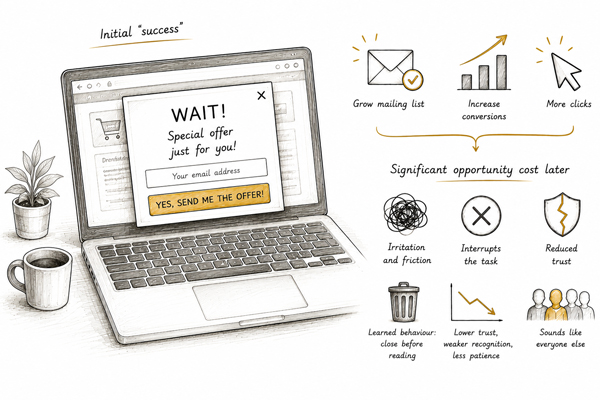
The metric may look great, but when we look at the engagement level of those users strong-armed onto a mailing list, we often see a lack of double opt-ins, a high number of unsubscribes and other signs that we shouldn’t be feeling too good about the primary metric. We’ve learned this about pop-up usage, but apparently we haven’t learned it about AI-generated copy yet.
AI-written communication can work in a similar way. It may increase output. It may make emails faster to write. It may improve clarity. It may even improve engagement in some situations, especially where the reader already trusts the sender and the AI is being used to organise a genuine message.
That matters. We shouldn’t ignore it.
The fact something appears to work does not mean it has no cost.
But the fact something appears to work does not mean it has no cost. It may simply mean the cost is harder to measure. If people begin to associate your communication with generic AI patterns, the damage may not show up neatly in this week’s analytics. It may show up later as lower trust, weaker recognition, less patience, and a vague feeling that your business sounds like everyone else.
And “sounds like everyone else” is rarely a good place to be.
A Springer Nature research summary makes a useful distinction here. It suggests consumer responses to AI-generated marketing are mixed. AI content can support credibility, engagement and purchase intent in some situations, especially through personalisation and logical persuasion. But it can struggle when authenticity or emotional resonance are required.
That seems like the line businesses need to pay attention to. AI may be very useful when the job is to organise, clarify or personalise information. But if the communication is trying to build trust, express care or convey lived expertise, the risks are different.
Some channels will become easier to ignore
When a communication channel fills with low-effort generated material, people adapt. They skim faster, trust less, and look for signals that something is worth their attention before they give it any.
You can already see this in cold outreach. Most people don’t need to carefully analyse whether a message was written by AI. They simply recognise the shape of it. It feels mass-produced. It feels over-familiar. It feels like a template with their name inserted, even when the wording is technically personalised. So they delete it.
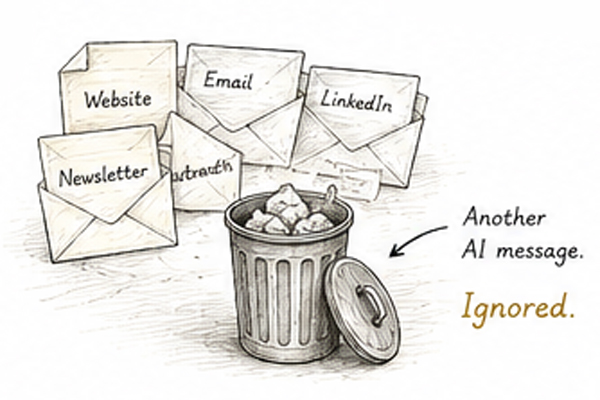
The same thing is happening with parts of LinkedIn, low-quality lead magnets, service websites that all sound the same, and AI-written books appearing in online marketplaces. It isn’t that every AI-assisted book, post or email is automatically bad. It’s that the average perceived value of the channel starts to drop when people are flooded with material that feels low effort.
When the barriers to publishing fall, the average quality of what gets published often falls with them. That does not mean there is no good work there, but it does mean readers have to filter harder.
Readers don’t have infinite energy. They protect their attention.
Readers don’t have infinite energy. They protect their attention. Once they learn a pattern, they start filtering it out. Our brains are amazing energy-saving machines. They are programmed to save energy for things that are worth it. The brain is lazy, so let’s not give it so many reasons to ignore us.
This is why obvious AI tells can be so damaging in high-value communication. You may only be borrowing a few phrases or structures from the machine, but if those phrases trigger the reader’s “I’ve seen this before” response, the rest of the message may never get a fair hearing.
Human communication may become more valuable, not less
There’s an interesting comparison here with vinyl records.
On paper, vinyl should not have much of a place in a world of streaming. Streaming is easier, faster, cheaper and more convenient. You can access almost anything instantly from a device in your pocket.
And yet vinyl has increasing value to a growing number of young people who have grown up in the relatively sterile and narrowly sensory experience which is streaming music.
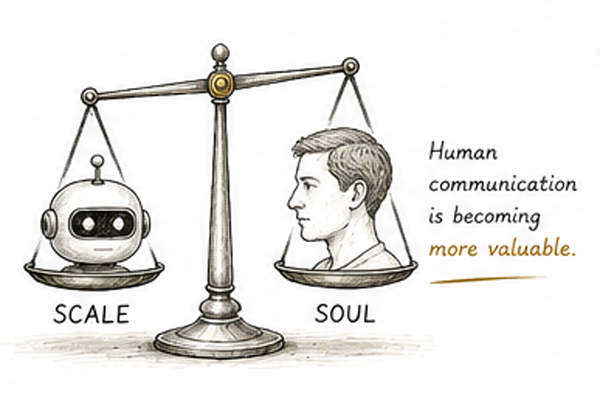
Not because vinyl scales better and not because it’s more efficient, but because it creates a different kind of experience. There’s the larger artwork, the tangible nature of the object, the ceremony of choosing a record, cleaning it, placing it on the turntable, and listening with a bit more intention. It isn’t just about the audio (although some would argue that point). It’s about the sense of occasion around listening to the music. It just makes it all a bit better. More memorable.
A handwritten note works in a similar way. Its value isn’t just the information it contains. It’s the signal behind it. Someone took time and care in communicating with you with intent.
It’s not just the information. It’s the signal behind it.
That doesn’t mean every business should stop using AI and start writing everything by hand. That would be silly. But as AI makes competent communication easier and cheaper to produce, genuinely human communication may become more valuable, stand out more and become a more significant differentiator in certain contexts.
Not everywhere. Not for every brand. Not for every message. But in high-trust situations, the human signal matters.
This also sits against a wider trust problem around AI. Research from the Nuremberg Institute for Market Decisions found that only 21% of respondents trusted AI companies and their promises, and only 20% trusted AI itself. That doesn’t mean people reject every AI-assisted message, but it does suggest businesses should be careful about using AI in places where trust is the main thing being built.
The answer is not to handwrite everything
There is an obvious counterargument to all of this, and it is a fair one.
Handwritten notes feel valuable because they do not scale. Vinyl feels special partly because it is slower, more physical and less convenient. But most businesses cannot operate as if every piece of communication is a handwritten note. If your competitors are using AI to publish faster, reply faster and produce more, pretending the tool does not exist is not much of a strategy.
I don’t think the answer is to personally craft every word. That would be reductive, and for many businesses it would be impossible. The more useful question is where AI belongs, how heavily we rely on it, and how much human attention different communication channels deserve. That should probably be reflected in a company’s content guidelines.
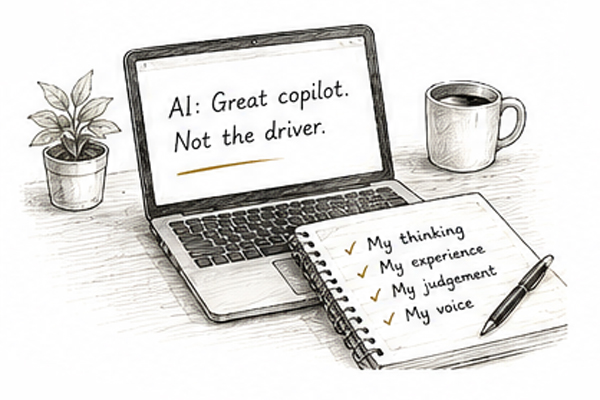
Some communication can be largely AI-assisted because the main job is speed, clarity or consistency. Internal summaries, rough drafts, first-pass documentation, meeting notes and operational updates are obvious examples. In those cases, AI can remove friction without carrying much brand risk.
But other communication deserves a much higher level of human involvement because the job is not just to move information around. The job is to build trust. That includes service pages, proposals, important client emails, personal newsletters, thought leadership, sales pages and anything where the reader is deciding whether they believe you.
The balance should also change depending on the audience. A broad, top-of-funnel audience may tolerate more AI-assisted communication because the relationship is loose. They do not know you yet. They are scanning for relevance. They may just need a clear explanation, a useful summary or a helpful starting point.
Top-of-funnel audience may tolerate more AI-assisted communication
But as the relationship gets closer, the proportion of human involvement should probably increase. A warm lead, a long-term subscriber, an existing client or a referral partner is not just reading for information. They are reading for continuity. They know your voice. They know how you think. They are much more likely to notice when something feels off.
That is where the risk is greatest.
Existing clients and audiences are hard won. They are expensive to earn and easy to take for granted. If they start to feel that the communication they receive from you has become automated, generic or strangely unlike you (go and Google the phrase ‘uncanny valley‘), the damage may not be immediate. But trust rarely disappears all at once. More often, it just peters out over time.
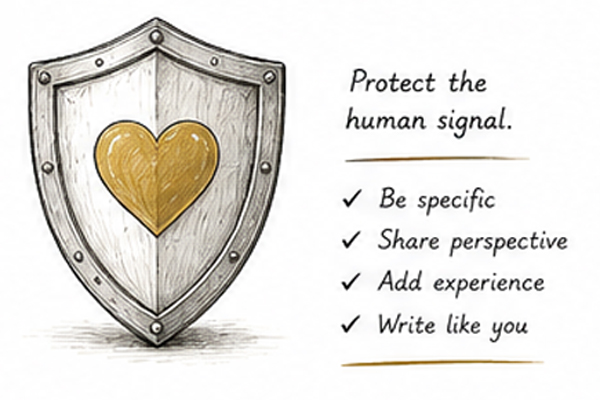
How to protect the human signal
If you’re using AI to help with business communication, I wouldn’t start by asking whether the copy “sounds good”. That’s too low a bar. A lot of AI copy sounds good, and that’s part of the issue.
Instead, ask:
- Could three of our competitors publish this unchanged?
- Is there a real opinion here?
- Is there a specific example from our experience?
- Does this sound like someone who has actually done the work?
- Are we saying something useful, or just sounding reassuring?
- Have we removed the phrases that feel polished but empty?
- Would someone who knows us recognise our voice?
- Is this communication pretending to be more personal than it really is?
- Where does this sit in the customer relationship: cold audience, warm lead, subscriber, client or long-term partner?
- Does this channel need speed and clarity, or trust and continuity?
- Are we using AI to clarify the thinking, or to replace it?
That last question is probably the most important.
AI is at its best when it helps clarify, structure and sharpen human thinking. It is at its worst when it gives the appearance of thought where none has really happened, or when it buries good thinking under a layer of generic polish.
The goal is not to hide AI use. The goal is to make sure AI does not hide the human value.
The real advantage is unique thinking
As AI-generated content becomes more normal, simply producing words will become less valuable. That does not mean writing no longer matters. It means the value moves elsewhere.
It moves to what you noticed, what you believe, what you have seen first-hand, what you are willing to say that a generic model would smooth over, and what trade-offs you understand because you have lived through them with real clients, real projects, real constraints and real consequences.
Clear human judgement becomes easier to spot.
For businesses like mine, and probably for many small consultancies and expert-led services, that may actually be an opportunity. If the web fills with competent, polished, forgettable communication, then clear human judgement becomes easier to spot. So does specificity. So does taste. So does a point of view.
The businesses that benefit most from AI will not be the ones that use it to sound human. They will be the ones that use it to get to the human part faster.
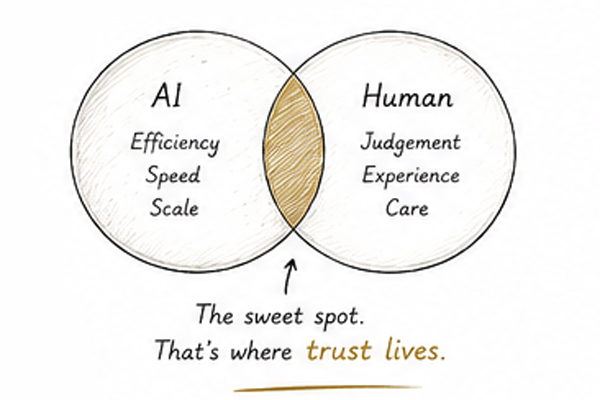
That means using AI to remove blockers, organise thoughts and speed up the rough work, but not outsourcing the judgement. Not outsourcing the opinion. Not outsourcing the care. And definitely not outsourcing the parts of the message that are supposed to build trust.
The real work now is deciding the division of labour. What can AI do safely? What should it only assist with? What needs a human finish? And what should remain predominantly human because the relationship is too valuable to risk?
Because the hidden cost of AI-written communication is not just that some of it sounds generic. It is that, used carelessly, it can make you sound generic too. And if your value is in your thinking, sounding generic is too high a price to pay.
Appendix: links mentioned
- The AI-authorship effect: Understanding authenticity, moral disgust, and consumer responses to AI-generated marketing communications, Journal of Business Research: https://www.sciencedirect.com/science/article/abs/pii/S0148296324004880
- Consumer Perceptions of AI-Generated Marketing Content, Springer Nature Link: https://link.springer.com/rwe/10.1007/978-3-031-75316-9_94-1
- Transparency Without Trust: Consumer attitudes toward AI-generated marketing content, Nuremberg Institute for Market Decisions: https://www.nim.org/en/publications/detail/transparency-without-trust